The Future of Investment in Global Cervical Cancer Elimination: A Lifesaving Vision at Risk
17 November, 2025
When women and girls have access to effective cervical cancer prevention, we can essentially reduce their risk of this preventable disease to zero.
Five years ago today, Member States of the World Health Organization ratified a groundbreaking new global strategy to accelerate the elimination of cervical cancer, the first-ever plan to eliminate any cancer. The strategy sets three programmatic global access goals:
- Vaccinating 90% of girls against human papillomavirus (HPV) by age 15;
- Screening 70% of women at ages 35 and 45 for precancerous cervical lesions; and
- Ensuring that 90% of women in need receive treatment for cervical disease.
The urgency cannot be overstated. Current estimates hold that over 660,000 women are diagnosed with cervical cancer every year, and over 342,000 women lose their lives to a disease we can easily diagnose and prevent. With so many women unable to access screening, the reality is that those numbers are likely far higher.
November 17th has been officially proclaimed as World Cervical Cancer Elimination Day – an important day to celebrate progress and rally decisionmakers, advocates, and practitioners to sustain efforts to save women’s lives.
Unfortunately, that progress has been uneven at best. Massive investments in HPV vaccination – largely due to funders of Gavi, the Vaccine Alliance – have pushed global HPV vaccine coverage above 27%. Meanwhile, support for cervical cancer screening and treatment – especially in low- and middle-income countries where the burden of cervical cancer is felt most profoundly – has remained essentially flat, with even insufficient funding levels at significant risk due to cuts in the United States support for global HIV/AIDS programming.
Funding commitments to date have not matched the resources necessary to make the global elimination plan a reality. With key donors actually reducing their commitments, it seems very unlikely that the scale-up goals will be met by 2030.
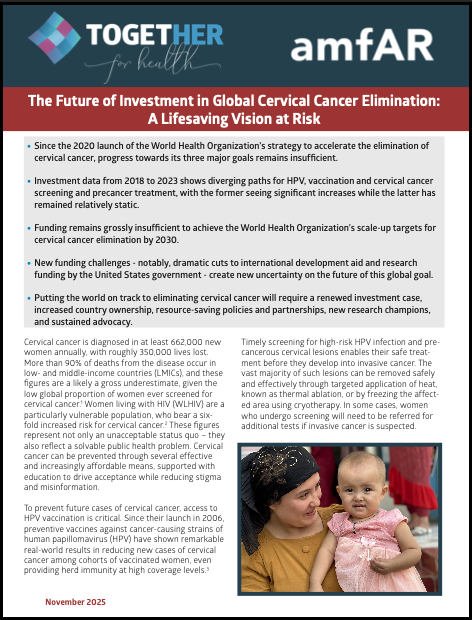
This year, TogetHER and amfAR joined forces to collaborate on a new report summarizing investment trends for cervical cancer prevention in low- and lower middle-income countries, describing the fraught environment for investment as it stands today, and recommending key actions to get the world back on track, including:
- Renewing the investment case to reflect new evidence and guidelines supporting more efficient and effective cervical cancer prevention strategies;
- Increasing country and regional ownership of cervical cancer, elimination, including through cost and comprehensive national plans;
- Utilizing policies and partnerships, such as pulled procurement that can reduce the cost of critical commodities and increase access;
- Identifying and supporting new public sector in philanthropic champions for research to improve interventions and implementation of cervical cancer prevention; and
- Sustaining much-needed advocacy in a time of global health uncertainty.
In a time of global health retrenchment, we must not let girls and women at risk of cervical cancer be left behind. It’s time for new champions to step up and for smart investments to maximize limited resources.
Five years ago today, the world stood as one to end cervical cancer. We call on leaders to act now so that five years from this date, we can celebrate a world closer to this unprecedented global goal.